About This Blog

A QualitEvolution is intended to capture positions and experiences as a participant in the evolution of the Quality profession into the 21st century. From its origins as the brainchild of Corporate Industrial Statisticians, our profession has transformed and evolved to incorporate and adapt to the demands and expectations of our modern existence.

The scope of the subject matter within A QualitEvolution extends to the furthest ranges of quality, business transformation, management science, and quality issues especially pertinent to the members of ASQ in Canada.


Tuesday, July 26, 2016

ASQ Canada - Proposals to Overcome Member Attrition in Canada


I wanted to raise for your attention the fact that in Region 4, there was a 15% overall drop in ASQ Membership numbers from month-to-month (see chart below comparing membership levels for June and July).   This seems excessive for a typical month-to-month change, and I wanted to explore the assignable causes for this significant decline.  The range of attrition by section was 8%-22%, and all ASQ Sections in Canada experienced a membership decline in the last month.  I would like to understand how this compares with overall ASQ trends between June and July 2016.  Even if the problems are not unique to Canada, the solutions proposed below can be applied to entrench and strengthen ASQ in Canada, and reverse this trend.


Analysis and Solutions


Since members do not leave abruptly but instead wait for their last expiry period, I think this relates to the non-renewals of the ASQ membership, plus a grace period for unpaid members.  Significant reductions in membership affect business planning, as membership levels, combined with participation rates, determine the estimates for attendance and capacity planning (i.e. banquet bookings, meeting room sizes).  


Today’s Canada-US exchange rate (0.76) makes the annual ASQ rate approximately $209 (a 27% increase over the last 3 years).   If this membership value is not recovered or recoverable by Canadian members, the attrition rates will continue and potentially increase.  Even if the new levels stabilize, we cannot sustain our membership or member units in Canada with 15-20% annual membership attrition rates.  This currency devaluation also affects the overall cost and participation rate of ASQ Certifications among ASQ Canada members, with the result that revenues and purchases of ASQ products and services will decrease overall in Canada.


I respectfully propose that ASQ consider adopting the following innovations to more effectively align to the expectations of the Canadian market, intended to reverse the evident member attrition:


-          Extend the capabilities of ASQ Customer Care to support ASQ members in Canada in both official languages (English and French), during core business hours (8AM-5PM) across all time zones (Newfoundland, Atlantic, Eastern, Central, Mountain, Pacific).


-          Offer French translations for ASQ Certifications (i.e. exams, training, webinars, and published material).


-          Price ASQ products and services at par for ASQ members based in Canada, with non-members paying the USD rates.  This at-par (i.e. ASQ membership is offered at $159 CAD) discount would incentivize Canadians to remain in ASQ and procure products and services.


-          Have ASQ HQ organize annual ASQ conference events with staff participation and support (similar to WCQI, Lean Six Sigma) in Canada.  This could be co-located with an ASQ BoD meeting or SAC/TCC training.  This would have the additional advantage of enabling ASQ to benefit from the 30% currency discount in Canada, relative to USA prices.


-          Allocate a proportionate ASQ infrastructure and staffing in Canada reflective of the membership.  Assuming a benchmark of 7.5%, this allocation could be devoted to Canada-based ASQ staff or staff specializing on unique Canadian concerns (i.e. tax planning for Revenue Canada not IRS, banking solutions with Canadian banks, etc.)


-          Allocate a minimum of 1 seat on the ASQ Board of Directors to a Canadian-based ASQ member.  If this is not already represented through SAC or TCC, then one of the Member At Large roles should be earmarked for a Canadian representative.


I know that these will not happen overnight.  My hope is that the necessary dialogues already started will continue and bear fruit.  I would like to build on the excellent discussions organized to reinforce the importance of the Canadian market to ASQ.


Saturday, July 9, 2016

ASQ Certification Preparation Resources


This is a link to the Question Banks and Certification training sessions offered by ASQ.  I am sharing this because with all of the changes to the Certification exams, there have been additional questions about the resources used to prepare for these exams.


For comparison purposes, please find below a sample of ASQ Certifications with their associated costs for Question Banks (practice questions) and Training.  This is not an all-inclusive list, but intended as a benchmark against which to compare similar offers you may encounter.  There is no "right price", and costs will vary according to instructor rate and facility rental charges.  Just ensure that your money is going to substance, not elegant lunches or impressive corporate rental space; for example, learning about Design of Experiments is equally effective over cold sandwiches in a modest classroom as it would be over tapas and hors d'oeuvres in leather chairs at the Yacht Club.


Certification
Level
Recertification Required
Question Bank
(member discount $10 USD)
ASQ HQ Training
(member discount $100 USD)
Certified Quality Technician
Practitioner
None
USD 99
USD 399
Certified Six Sigma Green Belt
Practitioner
None
USD 99
USD 599
Certified Lean Bronze
Practitioner
None
USD 99
USD 679
Certified Reliability Engineer
Professional
Every 3 years
USD 99
USD 699
Certified HACCP Auditor
Professional
Every 3 years
USD 99
USD 699
Certified Manager of Quality/ Organizational Excellence
Professional
Every 3 years
USD 99
USD 699


In general, the determining factors should be Cost Recovery and Return on Investment.  For these open-book exams, obviously self-study and a library card would provide the least expensive option.  However to improve the chances of success, a study regimen that includes a training course and practice questions is strongly recommended.

I also want to extend a personal caution of prudence with respect to time and money invested. 

- Only pursue exams and certifications for which you meet the minimum qualifications for work experience and body of knowledge proficiency.  The ASQ certifications are intended to reinforce existing capabilities for peer recognition.

- ASQ is not (USA Presidential candidate who shall not be named) University.  Don't max out your credit cards just to pay for training.  Work within your discretionary budget and where possible, use the buddy system to share notes and references.  Also connect with people who have previously taken the same exam to reuse their study materials.

- Training does not guarantee certification success, nor subsequent career growth and prosperity.  Training should elaborate and amplify the Quality Body of Knowledge with explanations and examples.  At best, it is part of an overall strategic approach to certification and knowledge enhancement.  Don't be oversold; manage your expectations accordingly.

- Support training with frequent and ongoing mentorship.  As a mentor, I have provided protégés with explanations, materials, and study tips without demanding cost for time or travel.  This is also a good reason to frequent ASQ events, in order to reconnect with mentors.

As a long-term ASQ member, I want to be part of a professional society populated with dedicated and thriving members who possess multiple ASQ certifications, at both the practitioner and professional levels.  If someone spends $$$$ just to get their first practitioner level credential, which won't actually lead to a lucrative management position, the promise and potential of ASQ certifications will not be realized.  Overspending leads to dissatisfaction, disengagement, attrition, and the decline of our profession. 

A better approach is to set a maximum ratio of training budget per certification ($1000 per exam) and look for creative ways to work within that allotment.  This will enable a long-term member to create and sustain an impressive portfolio of credentials, spanning practitioner and professional ASQ certifications, and making for a versatile and fully capable Quality resource.


Saturday, July 2, 2016

Canada's Historical Context - Understanding The Crown

On this Canada Day weekend, I wanted to share a graphic that explains the relationship of Canada to the Crown of the British Empire, and why we celebrate Canada Day, not Independence Day.


Canada is a country within the Commonwealth Realm, and operates within the Crown, currently held by Queen Elizabeth II.


This should also give the distinction of what constitutes the United Kingdom and how that is affected by the Brexit vote.  It is important to note that what occurs in the United Kingdom has a direct and profound effect throughout the world, particularly in Canada.


As we celebrate Canada, we should also recognize the history and heritage of our country.  Even with its multicultural demographic makeup, Canada is a country with very close ties to the United Kingdom, Great Britain, and the countries within the British Commonwealth.


Before Confederation was enacted on July 1, 1867, there were British Territories north of the border of the United States of America and the British Empire.  This border was established and ratified following the conflict of the war of 1812, and if not for the bravery of historical figures like Isaac Brock (who actually led the capture of Detroit by pro-British forces and native bands led by Tecumseh) and Laura Secord (who walked 20 miles to alert the British forces of a surprise American attack).


Canada's sovereignty grew incrementally through its history, and we must always remember and commemorate the history and legacy of those who enabled our nation to thrive and exist.

Saturday, June 11, 2016

ASQ Code of Ethics - Essential for Growth and Member Leader success

Earlier this year, I attended presentations which indicated the overall aspirations of ASQ to grow membership to new levels, which reveals enough to know that ASQ aspires to grow globally, and double its current membership through increased rates of member retention and Net Promoter Scores indicating positive VoC evaluations.


In a highly competitive era, the inclination is to broaden the base of ASQ by making it more accessible.  Many compromises can be made but one aspect that must remain intact is the requirement of every member and affiliate of ASQ to adhere to the ASQ Code of Ethics


http://asq.org/about-asq/who-we-are/ethics.html


For clarity, I have added the link and am pasting the ethics below.


I call upon all ASQ members to examine their own personal values and priorities.  If ASQ does not operate in a way that aligns with or reflects your own moral standards, that disconnect will create frustration and a disconnect which will be reflected in a low Net Promoter Score (NPS).  For the sake of ASQ and its aspirations, every member must be prepared to not only abide by the Code of Ethics themselves but promote its adherence among everyone involved.


Member Leaders who represent ASQ must do so in a way that effectively propagates the values and ideals of our profession and society.  For these essential volunteers, specific attention needs to be paid to Article 4: Acting in a professional manner and Article 5: Acting as faithful agents avoiding Conflict of Interest


As an ASQ Member Leader, ASQ Fellow, and active member in Year 20 of my association with ASQ, I can attest that the ASQ Code of Ethics is not only altruistic and aspirational, it is an essential and non-negotiable component to the preservation and sustainability of our society.


As an organization of volunteers (and I am including the superlative efforts of paid ASQ HQ staff who work over and above their normal job descriptions), trust and confidence are essential to establishing the foundation necessary for the enthusiastic "all-in" collaboration necessary for success.  The slightest hesitation will disrupt and diminish efforts and cause initiatives to whither and fail.


As an ASQ leader, I have to be especially vigilant to reinforce ethical conduct among those in my charge or bailiwick.  This may be my Waterloo, in which I am prepared to set aside personal popularity and conviviality to ensure that ASQ is not tarnished by potential fraud artists or malefactors.  I will not knowingly endorse or support an ASQ Member Unit or its leaders whom I know to be in contempt or deliberate violation of the ASQ Code of Ethics or Conflict of Interest Guidelines.


Sometimes a stalemate will be reached.  I am not the ASQ police, but only one member. If I reach a point that the leadership of an ASQ member unit refuses to cooperate or abide by these ethical principles, I will (and encourage others) to refer the matter to ASQ's Professional Ethics Committee. 


Code of Ethics

Fundamental Principles
ASQ requires its members and certification holders to conduct themselves ethically by:
  1. Being honest and impartial in serving the public, their employers, customers, and clients. 
  2. Striving to increase the competence and prestige of the quality profession, and 
  3. Using their knowledge and skill for the enhancement of human welfare.
Members and certification holders are required to observe the tenets set forth below:
Relations With the Public
Article 1 – Hold paramount the safety, health, and welfare of the public in the performance of their professional duties.
Relations With Employers, Customers, and Clients
Article 2 – Perform services only in their areas of competence.
Article 3 – Continue their professional development throughout their careers and provide opportunities for the professional and ethical development of others.
Article 4 – Act in a professional manner in dealings with ASQ staff and each employer, customer or client.
Article 5 – Act as faithful agents or trustees and avoid conflict of interest and the appearance of conflicts of interest.
Relations With Peers
Article 6 – Build their professional reputation on the merit of their services and not compete unfairly with others.
Article 7 – Assure that credit for the work of others is given to those to whom it is due.

Monday, May 30, 2016

Publishing at ASQ - Options and Links

ASQ provides members and participants in the Quality Community with ample opportunities to be published in the various magazines and journals.

I have provided some links to be directed to the appropriate websites and online forms to submit content for review and publication.

In addition to the local Section newsletters, ASQ has a range of magazines and journals which accept articles of all ranges and sizes.  

I have provided a job aid below to support any articles you may wish to submit for consideration to any of the larger ASQ publications.  I hope that this encourages you to not only become involved, but to consider obtaining and retaining an ASQ membership as part of your professional enhancement.


ASQ details are available at the Knowledge Center main page.


If you are interested in submitting a manuscript, you can follow the guidance at the links below.


Send manuscripts via e-mail to manuscripts@asq.org . Type the manuscript, double-spaced, and allow at least 1-in. margins.

  
The world’s largest publisher of quality related products, ASQ offers eight peer-reviewed journals and magazines covering a wide range of topics. 
Who has access?
·         Subscribers to any journal receive print issues for the subscription year plus online access to past issues
·         ASQ full, senior, fellow, and honorary members receive:
o    Quality Progress print subscription, plus online access to past issues
o    Online access to articles published before 2014 in the quarterly journals listed below 
(most recent issues are reserved for subscribers)
·         Associate and student members receive online access to current and past issues of Quality Progress
·         Organizational members and individuals linked to an organizational membership receive electronic access to current and past issues of all journals and magazines
·         All visitors can read sample open-access articles, browse journal and magazine tables of contents, and 
search all articles by publication, keyword, date, and more
Additional open-access and member-benefit publications are also available from topic- and industry-focused 
forums and divisions.
Follow the links below to subscribe to a publication or explore division/forum content offerings. 
Or join ASQ today for access to the most content.

MONTHLY


Quality Progress
ASQ’s flagship publication, read by more people than any other magazine on quality, features in-depth articles describing the application of innovative methods. Topics include knowledge management, process improvement, and organizational behavior.

QUARTERLY


Journal for Quality and Participation
Offers in-depth, comprehensive articles about employee involvement, teamwork, leadership, change management, and more.

Journal of Quality Technology
Covers the technical aspects of quality control, reliability, and related disciplines.

Quality Engineering
Co-published with Taylor & Francis, this journal examines in-depth, practical applications of quality technology for engineers.

Quality Management Journal
A source for practical application of quality research in the broad field of management.

Six Sigma Forum Magazine
The first magazine addressing the specific needs of Six Sigma professionals.

Software Quality Professional
Addresses the application of quality principles to the development and use of software and software-based systems.

Technometrics
Published in conjunction with the American Statistical Association, this journal focuses on statistics for the physical, chemical, and engineering sciences.

DIVISION AND FORUM PUBLICATIONS


Quality Approaches in Higher Education
An online, double-blind, peer-reviewed journal  that engages the higher education community in a discussion of improving quality and identifying best practices in higher education. Sponsored by the ASQ Education Division.

Quality Management Forum 
The quarterly refereed publication of the Quality Management Division (QMD). The Forum includes articles on quality management as well as information on QMD activities.

Primers on Human Development and Leadership
A core offering of the Human Development & Leadership Division, primers focus on topics related to personal and professional growth and leadership skills development.


Thursday, April 28, 2016

ASQ Quality Certifications - False Impressions and Valid Approaches

I am writing this as a staunch supporter of ASQ Certifications for Quality practitioners.  In the 18 years since I first committed to completing an ASQ Certification exam, I can attest that this investment has been thoroughly rewarding and satisfying.  The returns from a modest investment in cost, and a manageable time commitment that did not interfere with my day-job, have exceeded the price ten-fold, both within my day-job and as supplemental rewards as an instructor and author.
 
I think that all ASQ Certifications have merit and should be pursued and attempted, as a person's experience, aptitude, and capabilities permit.  If too much is spent training for just one certification (particularly a lower level credential), that is counter-productive and should be avoided.  One initiative I would like to undertake in the future is to prepare a unified reference for elements which are common across multiple Bodies of Knowledge, to enable an individual who is proficient in one area (i.e. CQE) to leverage that expertise toward credentials where the BoK overlaps (i.e. CSSGB, CSSBB).


The most important benefit of a diverse portfolio is the versatility and flexibility that come from having multiple qualifications.  In the absence of a crystal ball or oracle to accurately predict the future, the next remedy is to properly prepare for such circumstances.  Given the need for qualified people in advanced quality and technical fields, there is no wrong certification as everything can be applied and leveraged.
 
However I have also observed considerable confusion and misrepresentation concerning the training and certification for Quality certifications offered within and outside of ASQ.  I was fortunate to start my career during what I call the "TQM-era", when Quality was treated as a unified and confederated profession of aggregated skills and capabilities. 
 
My concern around this confusion is that providers, both within and outside of ASQ, are now starting to charge a significant financial sum ($ thousands !!!) to provide training for what are essentially open-book exams.  While people are free to spend their money as they wish, optimal financial returns will come from following this sequence and prioritization:
- Actual work experience in the Quality domain (technically a prerequisite for certification)
- Self-study from recommended resources (often the source books of the Body of Knowledge)
- Subscription to and participation in the appropriate ASQ Member Unit (example below include):
  • Software Division for CSQE,
  • Audit Division for CQA,
  • Reliability Division for CRE,
  • Biomedical Division for CBA,
  • Food, Drug, and Cosmetic Division for CHA,
  • Lean Enterprise Division for Lean Certifications,
  • Quality Management Division for CMQ/OE
 - Review of sample questions from a suitable question bank
- Tutorial or refresher sessions from peers and mentors with specific experience in the exam.  This should be organized by the Education or Certification Chair of your ASQ Member Unit (either a section or division)
- Core training from ASQ (webinars or live sessions); either from the ASQ Member Unit or ASQ Learning (ASQ HQ programs)
- Supplemental training from accredited post-secondary institutions
 
I recommend this as an alternative to the breadth and plethora of random providers who appear out of nowhere to suddenly declare themselves as universal experts.  My recommendation is to exercise caution and conduct due diligence on such organizations.  Behind the slick web pages and glossy advertising campaigns, you may find that the so-called "international experts" of 2016 are actually recent graduates or were in jobs or roles unrelated to their "expertise".  As a caution, a professional track record of at least 3 years should be adequate to validate the legitimacy of the business or consulting company and its practitioners, and permit a proper vetting of its testimonials and credentials.
 
One source of confusion came from the Six Sigma continuum, which adopted the lexicon of martial arts.  I have family members who are accomplished in the martial arts, and progression through the various belts was achieved based on demonstrated and judged proficiency across specific categories including forms, board breaks, weapons, sparring, and overall demeanor.  The novice belts reflect a lower level of accomplishment and complexity than higher belts.
 
In contrast, because there is no universal Six Sigma threshold, there are variations between proficiency levels.  An individual who obtains their Six Sigma Green Belt through ASQ is required to be proficient in many advanced statistical and experimental practices.  In contrast, a Master Black Belt from an unaccredited provider (a.k.a. diploma mill or airport hotel seminar) can receive certification without even knowing the basics of Statistical Process Control (for example when they attempt to track an attribute with an X-bar and R control chart). 
 
A similar source of confusion emerges with the Lean Certifications, which distinguish between Bronze, Silver, and Gold.  This has two interpretations:
- In competition, Gold is awards to the first place finisher, and Silver and Bronze are the subsequent prizes for second and third place.  This reference implies a superiority and infers that Silver and Bronze are deficient and tainted, when compared to the "Gold-standard"
- With respect to service levels, the terms of Bronze, Silver, and Gold refer to levels of care and commitment, with Gold being the premium.  In such cases, a cost-conscious consumer may opt for the Bronze option to avoid overspending on a "Gold-plated" alternative.  An example might be in sending a package by courier, where Bronze offers 2 business days, Silver is 1 business day, and Gold is same-day delivery.  If the price difference between Bronze and Gold exceeds the value derived from the benefit, the Bronze is the more prudent option.
 
To add to this confusion, some consulting groups are using additional terminology like Master or Sensei.  Master has significance (equivalence to the Germanic "Meister") in which a highly learned and competent tradesman or craftsman can oversee and mentor a Journeyman practitioner.  However since this also applies to professional and administrative applications, the trade analogy is not fully applicable.
 
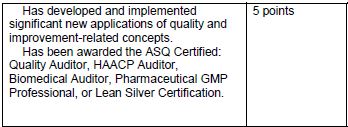
So how can we overcome false impressions?  ASQ, as part of its current evaluation scorecard for Fellow Member candidates, has distinguished and ranked its certifications, and assigned an appropriate score.  I share this objectively without prejudice or opinion.


Based on the ASQ Society Committee evaluation criteria for ASQ Fellows (when determining the top 0.1% of ASQ members in a given year), those individuals with a Master Black Belt are rated with the highest score.  This is reflective of not only the subject complexity, but the managerial and executive requirements for this Program-level role.


This also provides a mapping for the more obscure references (i.e. Six Sigma "Belts", Lean "Medals").
 
 Practitioner Level (Technician, Inspector, Green Belt, Lean Bronze)
This is targeted for the individual practitioner, and is not simple.  The scope of these credentials is intended to provide core knowledge.  The "entry-level" ASQ certifications in this category do not require recertification units to be submitted to ASQ every 3 years to retain certification.


Professional Level (Auditor, Professional, Lean Silver)
Professional considerations extend beyond personal expertise to support the evaluation and determination of suitability for products and systems. as well as the management of others, both within and outside of your control, to fulfill a particular objective or purpose.  Due to the professional nature and requirement for direct industry involvement, ASQ certifications in this category are required to be recertified every 3 years.


Program or Enterprise Level (Engineer, Manager, Black Belt, Lean Gold)
These certifications incorporate managerial and administrative items, along with team-building and development initiatives.  ASQ certifications in this category are required to be recertified every three years or else they will lapse and be invalid. 


I think that all ASQ Certifications have merit and should be pursued.  Instead of burning money on costly training by an unaccredited outside provider, work within ASQ and its infinite breadth of resources to build a personal library and Quality resource portfolio.  Perhaps the Practitioner-Level ASQ Certifications can be used as stepping stones to prepare for the more advanced credentials.  Share resources with colleagues and provide assistance and support where able.

An educated profession with legitimate and competent practitioners serves all of our mutual interests, and isolates those who falsely claim expertise.  The best remedy is professionalism, spanning from the novice individual Quality practitioner to the elaborate and experienced Quality program executive.


Friday, March 25, 2016

ASQ Society Membership

I was very delighted to read the recent View From The Q post by ASQ Chief Operating Officer, Ms. Shontra Powell.  Having had the pleasure to become personally acquainted, I will refer to the author as Shontra.


Before I comment on the well-researched and thought-provoking viewpoints expressed by Shontra, I wanted to first share some of my own analysis.  The ASQ Community Development team, through its Friday Fast Facts email publication, provides a link to Growth and Retention numbers for ASQ Sections in North America.


As there is a PAR Performance Award granted to ASQ Sections (in Good Standing) who demonstrate year over year success with membership growth and retention, I wanted to review the performance of sections in Region 4 (ASQ Canada), and compare that with other geographic regions.


My discovery was that in Canada, and across North America, ASQ is in a period of decline and diminished retention rates.  The current overall North America outcomes have a membership of approximately 60,000 members, with an annual growth rate of -4%, and a retention rate of 68% (based on the averages of totals for Sections). 


A review of the various ASQ sections identified a particular trend: Higher retention rates correlated with higher net growth rates.  This is logical, since sections with fewer members to replace can maintain and surpass their existing levels with fewer new members. 


Assuming that member growth is constant, the attribute which is within our control and which can determine overall membership levels is member retention.


According to this data, ASQ cannot hope to meet its growth targets until member retention is at or surpasses 80%. 


Among the insights within Shontra's post, the following would be constructive and beneficial toward the increased interest and engagement of our existing members, and consequently the basis for their long-term retention:
- Continued personal and professional growth (at member discounts with value and cost recovery)
- Part of connected physical and virtual communities
- Instant enhancements of knowledge through 24/7 portals and continuous information channels
- Breakthrough equity (I referred to this member value as "Loyalty Capital") which measures the worth of information and content.


I agree with Shontra, and the current numbers support that changes should be embraced.  In reality, the graphs will not be linear; demographic shifts and industrial changes will cause abrupt chasms to appear over the next 15-20 years as Baby Boomers leave the workforce.  If these changes are resisted or obstructed, the outcome will be the continued decline of our Society, until it must either be removed or absorbed into a more viable professional organization as one of its components.


If we do retain our membership, we will also retain the legacies and contributions of our Pioneers of Quality.  Member retention is essential to the preservation of our continuity and commitment to Quality. 


To you from failing hands we throw
The torch; be yours to hold it high.
If ye break faith with us who die
We shall not sleep