About This Blog

A QualitEvolution is intended to capture positions and experiences as a participant in the evolution of the Quality profession into the 21st century. From its origins as the brainchild of Corporate Industrial Statisticians, our profession has transformed and evolved to incorporate and adapt to the demands and expectations of our modern existence.

The scope of the subject matter within A QualitEvolution extends to the furthest ranges of quality, business transformation, management science, and quality issues especially pertinent to the members of ASQ in Canada.


Monday, May 30, 2016

Publishing at ASQ - Options and Links

ASQ provides members and participants in the Quality Community with ample opportunities to be published in the various magazines and journals.

I have provided some links to be directed to the appropriate websites and online forms to submit content for review and publication.

In addition to the local Section newsletters, ASQ has a range of magazines and journals which accept articles of all ranges and sizes.  

I have provided a job aid below to support any articles you may wish to submit for consideration to any of the larger ASQ publications.  I hope that this encourages you to not only become involved, but to consider obtaining and retaining an ASQ membership as part of your professional enhancement.


ASQ details are available at the Knowledge Center main page.


If you are interested in submitting a manuscript, you can follow the guidance at the links below.


Send manuscripts via e-mail to manuscripts@asq.org . Type the manuscript, double-spaced, and allow at least 1-in. margins.

  
The world’s largest publisher of quality related products, ASQ offers eight peer-reviewed journals and magazines covering a wide range of topics. 
Who has access?
·         Subscribers to any journal receive print issues for the subscription year plus online access to past issues
·         ASQ full, senior, fellow, and honorary members receive:
o    Quality Progress print subscription, plus online access to past issues
o    Online access to articles published before 2014 in the quarterly journals listed below 
(most recent issues are reserved for subscribers)
·         Associate and student members receive online access to current and past issues of Quality Progress
·         Organizational members and individuals linked to an organizational membership receive electronic access to current and past issues of all journals and magazines
·         All visitors can read sample open-access articles, browse journal and magazine tables of contents, and 
search all articles by publication, keyword, date, and more
Additional open-access and member-benefit publications are also available from topic- and industry-focused 
forums and divisions.
Follow the links below to subscribe to a publication or explore division/forum content offerings. 
Or join ASQ today for access to the most content.

MONTHLY


Quality Progress
ASQ’s flagship publication, read by more people than any other magazine on quality, features in-depth articles describing the application of innovative methods. Topics include knowledge management, process improvement, and organizational behavior.

QUARTERLY


Journal for Quality and Participation
Offers in-depth, comprehensive articles about employee involvement, teamwork, leadership, change management, and more.

Journal of Quality Technology
Covers the technical aspects of quality control, reliability, and related disciplines.

Quality Engineering
Co-published with Taylor & Francis, this journal examines in-depth, practical applications of quality technology for engineers.

Quality Management Journal
A source for practical application of quality research in the broad field of management.

Six Sigma Forum Magazine
The first magazine addressing the specific needs of Six Sigma professionals.

Software Quality Professional
Addresses the application of quality principles to the development and use of software and software-based systems.

Technometrics
Published in conjunction with the American Statistical Association, this journal focuses on statistics for the physical, chemical, and engineering sciences.

DIVISION AND FORUM PUBLICATIONS


Quality Approaches in Higher Education
An online, double-blind, peer-reviewed journal  that engages the higher education community in a discussion of improving quality and identifying best practices in higher education. Sponsored by the ASQ Education Division.

Quality Management Forum 
The quarterly refereed publication of the Quality Management Division (QMD). The Forum includes articles on quality management as well as information on QMD activities.

Primers on Human Development and Leadership
A core offering of the Human Development & Leadership Division, primers focus on topics related to personal and professional growth and leadership skills development.



Thursday, April 28, 2016

ASQ Quality Certifications - False Impressions and Valid Approaches

I am writing this as a staunch supporter of ASQ Certifications for Quality practitioners.  In the 18 years since I first committed to completing an ASQ Certification exam, I can attest that this investment has been thoroughly rewarding and satisfying.  The returns from a modest investment in cost, and a manageable time commitment that did not interfere with my day-job, have exceeded the price ten-fold, both within my day-job and as supplemental rewards as an instructor and author.
 
I think that all ASQ Certifications have merit and should be pursued and attempted, as a person's experience, aptitude, and capabilities permit.  If too much is spent training for just one certification (particularly a lower level credential), that is counter-productive and should be avoided.  One initiative I would like to undertake in the future is to prepare a unified reference for elements which are common across multiple Bodies of Knowledge, to enable an individual who is proficient in one area (i.e. CQE) to leverage that expertise toward credentials where the BoK overlaps (i.e. CSSGB, CSSBB).


The most important benefit of a diverse portfolio is the versatility and flexibility that come from having multiple qualifications.  In the absence of a crystal ball or oracle to accurately predict the future, the next remedy is to properly prepare for such circumstances.  Given the need for qualified people in advanced quality and technical fields, there is no wrong certification as everything can be applied and leveraged.
 
However I have also observed considerable confusion and misrepresentation concerning the training and certification for Quality certifications offered within and outside of ASQ.  I was fortunate to start my career during what I call the "TQM-era", when Quality was treated as a unified and confederated profession of aggregated skills and capabilities. 
 
My concern around this confusion is that providers, both within and outside of ASQ, are now starting to charge a significant financial sum ($ thousands !!!) to provide training for what are essentially open-book exams.  While people are free to spend their money as they wish, optimal financial returns will come from following this sequence and prioritization:
- Actual work experience in the Quality domain (technically a prerequisite for certification)
- Self-study from recommended resources (often the source books of the Body of Knowledge)
- Subscription to and participation in the appropriate ASQ Member Unit (example below include):
  • Software Division for CSQE,
  • Audit Division for CQA,
  • Reliability Division for CRE,
  • Biomedical Division for CBA,
  • Food, Drug, and Cosmetic Division for CHA,
  • Lean Enterprise Division for Lean Certifications,
  • Quality Management Division for CMQ/OE
 - Review of sample questions from a suitable question bank
- Tutorial or refresher sessions from peers and mentors with specific experience in the exam.  This should be organized by the Education or Certification Chair of your ASQ Member Unit (either a section or division)
- Core training from ASQ (webinars or live sessions); either from the ASQ Member Unit or ASQ Learning (ASQ HQ programs)
- Supplemental training from accredited post-secondary institutions
 
I recommend this as an alternative to the breadth and plethora of random providers who appear out of nowhere to suddenly declare themselves as universal experts.  My recommendation is to exercise caution and conduct due diligence on such organizations.  Behind the slick web pages and glossy advertising campaigns, you may find that the so-called "international experts" of 2016 are actually recent graduates or were in jobs or roles unrelated to their "expertise".  As a caution, a professional track record of at least 3 years should be adequate to validate the legitimacy of the business or consulting company and its practitioners, and permit a proper vetting of its testimonials and credentials.
 
One source of confusion came from the Six Sigma continuum, which adopted the lexicon of martial arts.  I have family members who are accomplished in the martial arts, and progression through the various belts was achieved based on demonstrated and judged proficiency across specific categories including forms, board breaks, weapons, sparring, and overall demeanor.  The novice belts reflect a lower level of accomplishment and complexity than higher belts.
 
In contrast, because there is no universal Six Sigma threshold, there are variations between proficiency levels.  An individual who obtains their Six Sigma Green Belt through ASQ is required to be proficient in many advanced statistical and experimental practices.  In contrast, a Master Black Belt from an unaccredited provider (a.k.a. diploma mill or airport hotel seminar) can receive certification without even knowing the basics of Statistical Process Control (for example when they attempt to track an attribute with an X-bar and R control chart). 
 
A similar source of confusion emerges with the Lean Certifications, which distinguish between Bronze, Silver, and Gold.  This has two interpretations:
- In competition, Gold is awards to the first place finisher, and Silver and Bronze are the subsequent prizes for second and third place.  This reference implies a superiority and infers that Silver and Bronze are deficient and tainted, when compared to the "Gold-standard"
- With respect to service levels, the terms of Bronze, Silver, and Gold refer to levels of care and commitment, with Gold being the premium.  In such cases, a cost-conscious consumer may opt for the Bronze option to avoid overspending on a "Gold-plated" alternative.  An example might be in sending a package by courier, where Bronze offers 2 business days, Silver is 1 business day, and Gold is same-day delivery.  If the price difference between Bronze and Gold exceeds the value derived from the benefit, the Bronze is the more prudent option.
 
To add to this confusion, some consulting groups are using additional terminology like Master or Sensei.  Master has significance (equivalence to the Germanic "Meister") in which a highly learned and competent tradesman or craftsman can oversee and mentor a Journeyman practitioner.  However since this also applies to professional and administrative applications, the trade analogy is not fully applicable.
 
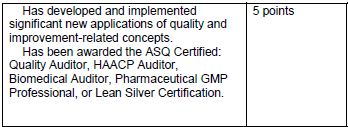
So how can we overcome false impressions?  ASQ, as part of its current evaluation scorecard for Fellow Member candidates, has distinguished and ranked its certifications, and assigned an appropriate score.  I share this objectively without prejudice or opinion.


Based on the ASQ Society Committee evaluation criteria for ASQ Fellows (when determining the top 0.1% of ASQ members in a given year), those individuals with a Master Black Belt are rated with the highest score.  This is reflective of not only the subject complexity, but the managerial and executive requirements for this Program-level role.


This also provides a mapping for the more obscure references (i.e. Six Sigma "Belts", Lean "Medals").
 
 Practitioner Level (Technician, Inspector, Green Belt, Lean Bronze)
This is targeted for the individual practitioner, and is not simple.  The scope of these credentials is intended to provide core knowledge.  The "entry-level" ASQ certifications in this category do not require recertification units to be submitted to ASQ every 3 years to retain certification.


Professional Level (Auditor, Professional, Lean Silver)
Professional considerations extend beyond personal expertise to support the evaluation and determination of suitability for products and systems. as well as the management of others, both within and outside of your control, to fulfill a particular objective or purpose.  Due to the professional nature and requirement for direct industry involvement, ASQ certifications in this category are required to be recertified every 3 years.


Program or Enterprise Level (Engineer, Manager, Black Belt, Lean Gold)
These certifications incorporate managerial and administrative items, along with team-building and development initiatives.  ASQ certifications in this category are required to be recertified every three years or else they will lapse and be invalid. 


I think that all ASQ Certifications have merit and should be pursued.  Instead of burning money on costly training by an unaccredited outside provider, work within ASQ and its infinite breadth of resources to build a personal library and Quality resource portfolio.  Perhaps the Practitioner-Level ASQ Certifications can be used as stepping stones to prepare for the more advanced credentials.  Share resources with colleagues and provide assistance and support where able.

An educated profession with legitimate and competent practitioners serves all of our mutual interests, and isolates those who falsely claim expertise.  The best remedy is professionalism, spanning from the novice individual Quality practitioner to the elaborate and experienced Quality program executive.


Friday, March 25, 2016

ASQ Society Membership

I was very delighted to read the recent View From The Q post by ASQ Chief Operating Officer, Ms. Shontra Powell.  Having had the pleasure to become personally acquainted, I will refer to the author as Shontra.


Before I comment on the well-researched and thought-provoking viewpoints expressed by Shontra, I wanted to first share some of my own analysis.  The ASQ Community Development team, through its Friday Fast Facts email publication, provides a link to Growth and Retention numbers for ASQ Sections in North America.


As there is a PAR Performance Award granted to ASQ Sections (in Good Standing) who demonstrate year over year success with membership growth and retention, I wanted to review the performance of sections in Region 4 (ASQ Canada), and compare that with other geographic regions.


My discovery was that in Canada, and across North America, ASQ is in a period of decline and diminished retention rates.  The current overall North America outcomes have a membership of approximately 60,000 members, with an annual growth rate of -4%, and a retention rate of 68% (based on the averages of totals for Sections). 


A review of the various ASQ sections identified a particular trend: Higher retention rates correlated with higher net growth rates.  This is logical, since sections with fewer members to replace can maintain and surpass their existing levels with fewer new members. 


Assuming that member growth is constant, the attribute which is within our control and which can determine overall membership levels is member retention.


According to this data, ASQ cannot hope to meet its growth targets until member retention is at or surpasses 80%. 


Among the insights within Shontra's post, the following would be constructive and beneficial toward the increased interest and engagement of our existing members, and consequently the basis for their long-term retention:
- Continued personal and professional growth (at member discounts with value and cost recovery)
- Part of connected physical and virtual communities
- Instant enhancements of knowledge through 24/7 portals and continuous information channels
- Breakthrough equity (I referred to this member value as "Loyalty Capital") which measures the worth of information and content.


I agree with Shontra, and the current numbers support that changes should be embraced.  In reality, the graphs will not be linear; demographic shifts and industrial changes will cause abrupt chasms to appear over the next 15-20 years as Baby Boomers leave the workforce.  If these changes are resisted or obstructed, the outcome will be the continued decline of our Society, until it must either be removed or absorbed into a more viable professional organization as one of its components.


If we do retain our membership, we will also retain the legacies and contributions of our Pioneers of Quality.  Member retention is essential to the preservation of our continuity and commitment to Quality. 


To you from failing hands we throw
The torch; be yours to hold it high.
If ye break faith with us who die
We shall not sleep

Tuesday, March 8, 2016

CSQE Source Material - Dated, More Current Sources Required


When there are discussions about the relevance and applicability of an ASQ Certification, it is important to review the source material from which the certification is derived, and which it uses to create exams.


ASQ is in the software quality domain.  I have recently taken on a commitment to craft practice exam questions.  The reference list is below.  Given that we are now in 2016, I will highlight the relative ages of the reference.  Then consider how much software has evolved.
 
The range is 21 years with the newest publication 6 year old, and the oldest 27 years.  I plugged this into MS Excel and got the following


14.6
Mean
13.5
Median
12
Mode


It will be very difficult to convince people that CSQE is relevant for 2016 when the cluster of books was written in the prior generation.  Most software products from the early 2000s are past end-of-life and need to be retired or replaced.  In addition, there have been many trends and advances in software and applications which this material does not address or consider because these practices were not yet functional:


- Mobile applications "apps"
- Software as a service
- Social media and platforms
- Open access freeware
- Sharing services
 
It is not my intent to disparage the excellent resources below.  I have put in bold those particular references which I personally possess and highly recommend.


However I believe that this foundation of material should be augmented with more contemporary resources in Software Quality, particularly in the relevant Software QA issues of 2016 and beyond.


CSQE Reference List 2015
These books cover the parts of the Body of Knowledge. ASQ Certification Board does not endorse any one particular reference source.


8 years – obsolete by 2015 version
Ø ANSI/ISO/ASQ Q9001-2008: Quality Management Systems: Requirements. (new revision) T860 (E)


Valid
Ø ASQ Code of Ethics http://www.asq.org/about-asq/who-we-are/ethics.html


22 years
Ø Booch, Grady, Objected-Oriented Analysis and Design with Applications 2nd ed., Addison-Wesley Publishing Co., Inc., 1994. ISBN 0805353402


6 years
Ø Capability Maturity Model® Integration (CMMI), CMMI® for Development, Version 1.3, August 2010.


14 years
Ø Daughtrey, Taz, ed., Fundamental Concepts for the Software Quality Engineer, ASQ Quality Press, 2002. H1115


14 years
Ø Futrell, Robert T., Donald F. Shafer, and Linda I. Shafer, Quality Software Project Management, Upper Saddle River, NJ: Prentice Hall, 2002. ISBN 0130912972


23 years
Ø Gilb, Tom, and Dorothy Graham, Software Inspection, London: Addison-Wesley Professional, 1993. ISBN 0201631814


9 years
Ø Gryna, Frank M., Richard C.H. Chua, and Joseph A. Defeo, Juran’s Quality Planning and Analysis for Enterprise Quality, 5th ed., New York: McGraw-Hill, 2007. P1237


21 years
Ø Humphrey, Watts, A Discipline for Software Engineering, Reading, Mass: Addison-Wesley, 1995. ISBN 0201546108


27 years
Ø Humphrey, Watts, Managing the Software Process, Reading, Mass: Addison-Wesley, 1989. ISBN 0201180952


17 years
Ø Juran, Joseph M., Juran’s Quality Handbook, 5th ed., New York: McGraw-Hill, 1999. P660


13 years
Ø Kan, Stephen H., Metrics and Models in Software Quality Engineering, 2nd ed., Boston: Addison-Wesley, 2003. ISBN 0201729156


17 years
Ø Kaner, Cem, Jack Falk, and Hung Quoc Nguyen, Testing Computer Software, 2nd ed, Wiley Computer Publishing, 1999. ISBN 0471358460

12 years
Ø Keyes, Jessica, Software Configuration Management, CRC/Auerbach Publications, 2004, 0-8493-1976-5


21 years
Ø Kit, Edward, Software Testing in the Real World: Improving the Process. Addison-Wesley Publishing Co., 1995. ISBN 0201877562


20 years
Ø Lyu, Michael R., Handbook of Software Reliability Engineering, Los Alamitos: IEEE Computer Society Press, New York: McGraw-Hill, 1996. ISBN 0070394008 Complete book available online at http://www.cse.cuhk.edu.hk/~lyu/book/reliability/index.html


12 years
Ø Myers, Glenford J., The Art of Software Testing, 2nd ed., New York: John Wiley & Sons, 2004. ISBN 0471469122.


20 years
Ø Myerson, Marian, Risk Management Processes for Software Engineering Methods, Boston: Artech Computer House Library, 1996. ISBN: 0890066353


9 years
Ø Poppendieck, Mary and Tom, Implementing Lean Software Development, Addison-Wesley: Upper Saddle River, NJ, 2007. ISBN 0321437381


12 years
Ø Pressman, Roger S., Software Engineering: A Practitioner’s Approach, 6th ed., New York: McGraw-Hill, 2004. ISBN 007301933X


15 years
Ø Rakitin, Steven R., Software Verification and Validation for Practitioners and Managers, 2nd ed., Boston: Artech House, 2001. ISBN 1580532969, PDF download ISBN B000066FYE


10 years
Ø Russell, J.P., ed., ASQ Quality Audit Division, The ASQ Auditing Handbook, 3rd ed., Milwaukee: ASQ Quality Press, 2006. H1263


13 years
Ø Scholtes, Peter R., Brian L, Joiner, and Barbara J. Streibel, The Team Handbook, 3rd ed., Oreil Inc., 2003. P1030


8 years
Ø Schulmeyer, G. Gordon, Handbook of Software Quality Assurance, 4th ed., Boston, MA: Artech House, 2008. ISBN 9781596931862, 1596931868


7 years
Westfall, Linda, The Certified Software Quality Engineer Handbook. ASQ Quality Press, Milwaukee, 2009. ISBN: 987-0-87389-730-3


Thursday, March 3, 2016

ASQ Members - Synchronize ASQ Certifications for fun and profit

This is a particular message which, if I do nothing else in ASQ, I hope will be associated with any legacy I may have.


To paraphrase Winston Churchill, I am a modest man because I have much to be modest about. In my middle age, my aspirations have shifted so that on a good day, I can claim to be punctual, polite, and have good personal hygiene.  Unfortunately in 2016, possession of these three attributes concurrently elevates one to the top percentile of society.


As far as the merits and benefits of ASQ certification are concerned,  I defer to the many articles already published in ASQ Quality Progress, along with the excellent ASQ video available on YouTube.


https://www.youtube.com/watch?v=tF7Ira74tJ4


With respect to synchronizing certifications, I wanted to share some insight.


I have been synchronizing my certifications for 15 years, and consequently have been able to retain the original certifications I attained back in the mid-late 1990s.  I have always appreciated this member benefit, but it was only recently that I realized that non-members of ASQ who wish to recertify their credentials have to do so individually at a substantially higher rate.


Assuming that the non-member does not abandon their certification or lets it lapse, the long-term commitment of a perpetual certification is $109 USD, payable every 3 years, for the rest of a career.  For someone who achieved their credentials in their 20s and 30s, that could result in funding an additional 10-12 renewal cycles. This adds a long-term cost of $1000-1500 per renewable ASQ certification, unless ASQ member discounts are applied.


This long-term consideration is generally not considered, but let's say that a practitioner with 4 certifications (CQA, CQE, CSSBB, and CMQ/OE) wants their ASQ credentials to be relevant for the next 15 years (5 renewal cycles).  The chart below show that the member would save over $400 USD by renewing these as an ASQ Member, and these savings would be compounded 5 times, giving a nominal long-term member benefit of $2000 USD (even more when the time-value of money is considered).


To those ASQ members with 1 or fewer renewable certifications, the benefits of certificate synchronization do not apply.  Not all career models are served by having multiple certifications, but I personally advocate that a managerial CMQ/OE complements the technical certifications like CQE, CRE, or CSQE.


According to the current pricing model, certificate renewal brings incremental advantages over a 3 year period.  Let's drop the whole 9 and round up prices numbers divisible by 10. 


Every 3 years, the certifications have to be renewed.  The savings of doing renewals within an ASQ membership (and available discounts) are immediately available on the first certification, and if you are renewing 5 or more, the cost recovery from the money saved actually exceeds the cost of ASQ membership.  This means that the investment of ASQ membership is recovered every 3 years through certification renewal savings alone.  It's a good deal, and one of the most valuable and under-publicized benefits of a long-term commitment to ASQ.


Monday, February 15, 2016

Involvement - It Only Works If You Use It

Currently I am involved with a few organizations, but there are two which I would like to highlight: American Society for Quality (ASQ) and the YMCA. 


My YMCA is a family membership, which our family uses for swimming and exercise programs.


The ASQ membership is a professional society, which I have used for the last 20 years to support and enhance my career and professional development.


Imagine making the monthly or annual payments, only to not partake in the many benefits.  I can't lose weight or improve my fitness and stamina unless I actually go to the YMCA, use the equipment or facilities, or take part in the lessons and workout sessions.  There are additional benefits, when compared to similar organizations.  The fitness coaching is excellent, and offered at a less expensive rate.  However I often find the workout facilities to be empty (except at peak times), providing opportunities to almost have a private gym experience.


With respect to ASQ, there are abundant benefits, but only if these are actually used.  By following a normal and expected pattern of professional involvement, a member should be able to recover their investment in member value or discounts every three years, if not sooner.


- Member discounts on events and programs provide a short-term incentive.
- The member rate for certifications justifies the membership cost
- Members have the ability to synchronize multiple certifications for renewal, which saves $70 per certification every three years.  This is a significant benefit for those with 3 or more renewable certifications
- Attendance at conferences offsets the membership costs, particularly if the conference fee is subsidized or waived for speakers, reviewers, or moderators
- Subscriptions to quality journals and publication purchases provide additional member discounts
- There are opportunities to encounter influential and accomplished practitioners in informal setting, enabling mentoring and guidance.  This is superior to the "pay-to-play" professional coaching model which may or may not result in successful outcomes.
- Strategic purchasing and portfolio management (i.e. upgrade to Senior Member, renew at least 1 month in advance) will generate additional discounts within ASQ.


Involvement in an organization can be rewarding and support personal and professional goals.  However for it to work, it has to align with your particular situation, and the mentality has to complement the core values and principles. 


In the 20 years since I have become acquainted with ASQ, I have discovered a combination of credentials and activities that unleashes the best value and member satisfaction for me.  While this won't work for everyone, I believe it describes a level to which every ASQ member should aspire before judging whether ASQ is valuable and beneficial.


- Join as a Full Member and at the earliest opportunity, upgrade to a Senior ASQ membership


- Renew early (1 month early) to remain in good standing and be eligible for additional incentives and benefits


- In addition to your home section, join a minimum of 1 ASQ Division.  The more you join, the more communities and opportunities are available to you to pursue professional involvement


- Pursue, achieve, and sustain your status in a minimum of 2 renewable ASQ certifications


- Attend a major ASQ conference (i.e. WCQI, JTCC) at least once every three years to experience the high energy personal connections


- Get involved at the section, division, regional, and society levels as a volunteer, committee member, member-leader, competition judge, or other capacity.


- Support learning as an instructor, reviewer, exam proctor, or intellectual property author for the ASQ materials related to certification and Quality Body of Knowledge


- Subscribe, review, and produce publications and presentations.  This will not only enhance your stature, but may make you eligible for honoraria or royalties.


I did these very steps within the first five years, and consequently it has helped my ASQ long-term engagement.  From this foundation, I have been able to recover my investment in ASQ many times over, ten-fold would be very modest. 


Consider the alternate approach.
- Restricting to an Associate or Student Membership limits the benefits and opportunities
- Late or missed renewals affects continuity, and deprives the member of potential benefits
- Confining membership to 1 section or virtual removes networking opportunities
- Not attending a conference will limit the perception of ASQ to small-scale meetings with lower energy


Minimal involvement will produce minimal results.  You won't burn calories or build strength if you only visit the gym 6 times a year, and you won't develop professionally unless it becomes a priority and essential part of your schedule.


Involvement in ASQ is great, but only if it works.  My personal challenge is for each an every member to aspire to the following as a minimum:
- ASQ Senior Member (to get the ASQ journal benefit)
- Achievement of two or more renewable ASQ certifications (to get the synchronized recertification benefit)
- Affiliation with two or more ASQ Divisions (to expand opportunities for networking and involvement)


Fear Of Missing Out - You can overcome that fear with involvement, which is within your control.

Friday, January 29, 2016

MONOPOLY - Strategies and Lessons Learned

With the popularity of Donald Trump, for some reason I have been inclined to spend more of my time playing Monopoly.  I play online because it is the quickest, though I also enjoy live board games as well with real people


My general strategy is to acquire the less expensive properties and quickly build up houses.  I have learned that since there are only 32 houses available, my strategy is to try to consume these houses prior to having any of my opponents in a position to purchases houses on their own properties.


Once the houses are consumed, I then focus on acquiring the railroads and utilities.  If opponents are short of cash, they are often more willing to make trades.


Here is an example from a game where I had the 3 ideal color sets, railroads, and utilities, and consumed all of the available houses.


An alternate game shows the same strategy.  Because I had the blue color set first, I ended up having to place a hotel on a less expensive property to ensure that I had sufficient houses available.


I have contemplated this game and thought of some different phases which reflect the different stages of Monopoly competition.   This could be used to more clearly understand our own behaviors to particular situations.


1. Opening Optimism:
This is the initial phase where all players are keen to take their turns and make every purchase possible.  This is analogous to the initial burst of enthusiasm when starting a new venture.


2. Steady Gathering:
Through the next stage, all of the participants are relatively equal and gather their properties and assets in a way that will position their next step.  This methodical approach sets the foundation for future opportunities.  Long-term goals are critical.  In my personal case (with respect to Monopoly), because I target the less expensive properties, my opponents are more willing to make individual trades which appears to their short-term advantage, but enables the achievement of my ultimate objectives.


3. Risky Venturing:
If I am fortunate enough to get a color set, giving me a monopoly, I generally purchase houses that will provide more rental income.  To do this, I have to sacrifice cash, even mortgaging my other properties to enable this initiative.  This is risky because if my expenses or penalties exceed my current cash flow, I will have to sell my houses at a 50% loss.  If the properties return income, that will justify the short-term cash restrictions.


4. Prosperous Growth:
Once the properties are established, they become the foundation for future growth and ultimately the consumption and acquisition of my opponents' properties and assets.  In this phase, I am confident and anticipate every turn as a potential source of income, property acquisition, or advantage.


5. Futility and Defeat:
No strategy is foolproof.  Sometimes the opponents have good fortune and are able to build up their properties earlier.  In this stage, I am hesitant to take my turn, hopeful to avoid paying high rentals, and if I do land in jail, I will remain as the safety of jail is preferable to the risk of financial ruin.


6. Absurdity:
Sometimes the opponents will conspire and make unreasonable trades with each other to enable their success.  Paying 5X the property value will enrich one opponent at the expense of another outside of my control.  This happens in both automated and real-life Monopoly competition.  If someone wants to do this, it is not necessarily rational but then neither is life.


So this in Monopoly, and every player has their own strategy.  I would probably resemble the father of Donald Trump, Fred Trump who made his fortune with lower income housing in a less visible and prestigious part of New York City.  In contrast, Donald Trump was more flamboyant and would be the player who gravitated to Park Place and Boardwalk (or their international equivalents)


Now think about your attitude to work and life.  Do you charge out in the morning, chasing every opportunity?  Do you make risky ventures with the expectation of a great payoff.  Are you simply gathering your modest gains randomly, or are they targeted for a greater future opportunity?  Most importantly, are you hiding from life's challenges, or are you embracing and tackling those entities in your path.


The most important thing I have learned is to have a clear plan and work toward that plan.  Maybe it is not the best plan for everyone, but it works for me.  When I play online, I generally play against 3 opponents.  By random selection, I should only win 25% of the time, but by focusing and prioritizing on building properties in the range between Reading Railroad and Free Parking (squares 6-19 from Go), my success rate is between 65-70%, even when playing with top opponents.


Always be building up and improving.  Sometimes a calculated risk is necessary to get to a desired level.  In real-life terms, this may involve taking time away from work to focus on school, or leaving the predictable income levels of a full-time job to start a new business venture. 


Back to Donald Trump.  My impression is that he spent a lifetime preparing to be an overnight political success.  Consider how unlikely it is that a citizen who has never previously held nor been officially nominated for public office has challenged and surpassed opponents with far more extensive backgrounds in public service and elected office.  Whether or not he got elected, nobody can doubt that if presidential politics were a Monopoly board, Mr. Trump would be the one with the hotels and houses on his properties, anticipating a windfall every time someone landed on his square.

Monday, January 25, 2016

Student Strategy for ASQ - Emphasize Today's Benefits

There are a lot of efforts and initiatives to engage students into ASQ.  This is a very promising demographic, and the energy, vitality, and zeal for innovation exhibited by the students will enrich ASQ and make it a better organization.

In pursuing this group, we have to consider their needs, their capability to participate, and the benefits that will help them today for their professional advantages tomorrow.

How do the ASQ Advantages apply to students?

1. Training and certification:
Many of the training options and certifications are available for those at the starting point of the profession.  Having a credential like the CQIA (Certified Quality Improvement Associate) may appear elementary to the Black Belts and Quality Managers among us, but it can certainly distinguish a new professional from the pack.  The cost is modest, and the connection to other ASQ Certified professionals is valuable and enduring.

2. Interaction with active networks:
While others have to wait for the job ads to appear, and submit their resumes as part of a "cattle call" hiring process, students who are connected to an active ASQ network are tapped in and made aware of potential opportunities in the earliest stages.  Not only is there an early awareness of potential jobs or contract opportunities, quite often the hiring manager is also an ASQ member, permitting a solid interaction to occur.

3. Participation in projects to showcase skills:
Students will face the common dilemma: they can't get hired without work experience, and they can't get work experience until they are hired.  ASQ provides project opportunities, in a non-profit manner, to permit students to showcase their skills and work ethic.  If this helps ASQ and the immediate cluster of companies or organizations close to ASQ, then a reciprocal benefit could occur whereby the students can leverage that positive impression into a full-time role or contracting opportunity.

4. Comity and mobility:
In our global society, opportunities may arise outside of your immediate geographic location.  ASQ provides a connection across cities, states, provinces, and countries.  A Six Sigma Green Belt earned through ASQ's rigorous and stringent examination process will carry equal weight and validity wherever ASQ operates or has a visible presence.  This is an advantage for the student, who can get credentials through ASQ in rural Canada or India, and apply these certifications to demonstrate their qualifications for a role based in Texas or the United Kingdom.

5. Exposure to real-life examples of quality:
New graduates are often derided as having "theory".  ASQ recognizes the importance of academic achievement, and complements that with various forums from which a member can become acquainted with the successful application of quality practices, and the positive impacts on business outcomes and customer satisfaction.

This is not an exhaustive list, but simply the tip of the "ASQ Iceberg", as there are more benefits not mentioned above.  Of course, these benefits are dependent on the willingness of the ASQ Member Unit to engage and support student members.  As more people learn and understand the benefits, they can embrace and sustain not only student membership, but overall member retention.

I have a vested interest in the infusion of diverse cultures and age demographics.  Our ASQ composition should reflect the actual Quality workforce in heritage and attitude.  I want to experience and encounter the global potential and possibilities of our professional community, and that has to start with the way we attract and engage our members with the most vitality - the student communities.

Tuesday, January 5, 2016

Culture of Quality - Awareness, Interest, Decision, Action

In response to the excellent blog post in the View from the Q on Corporate Culture I am suggesting that the leaders in this situation apply the AIDA method, and strive to gain and promote Awareness, Interest, Decisions, and Actions within the organization.

The scenario appears to reflect deficiencies in all four areas, particularly the blockages between different levels and layers of the organization.

Awareness is critical.  Once different groups and stakeholders recognize the interdependencies of their actions, prerequisites and entry criteria can be properly established.  A consistent methodology can be deployed which complements and addresses all of the necessary functions.  If there are extraordinary circumstances (i.e. shortage of operating capital), then innovative solutions can be developed and applied to mitigate or eliminate the situations.

Interest is important.  For any constructive and sustained change to occur, it has to be presented in a way that captures and creates a genuine interest across all parties, who will see and experience the benefit of those changes.  While people should not have to be "sold" on diligence or compliance, the manner of achieving that diligence should be examined.  For example, an abusive and toxic culture may generate immediate improvements in the short term, but will contribute to absenteeism, attrition, and a loss of continuity and reputation in the long-term.  A better approach is effective employee engagement and empowerment.

Decisions are critical for correct improvements.  The case study makes reference to the fact that the line employees cannot get to senior management, who won't respond to emails nor be available for calls.  My personal opinion would be to inject the decision-makers into the "Gemba" or location of the actual work so that they can gain first-hand exposure to the situation, and make rapid decisions to authorize improvements or investments in improved quality and operations.

Actions define the next steps, and ultimately guide the development of the corporate culture.  For example, if an employee is terminated for refusing to ship a deficient product, that will send the message that delivery schedules override quality standards, and deficiencies should be concealed.  If on the other hand, the company commends the employee and takes the necessary actions to resolve the quality problems, that will send encouraging motivation for others to advocate quality and integrity.

There are no immediate solutions.  Improvements are incremental and must be reinforced with each shipment or issue managed and resolved.  Transparency and visibility are critical to accurate and precise solutions.  Expectations must be managed, and one option is for the company to pull back from business opportunities until they can be properly served and fulfilled.  It is better for an organization to build a stellar reputation by doing a few solutions or deliverables at a high standard, than by stretching too thin to be all things to all customers.

Culture: Awareness, Interest, Decision, Action.  Without these elements, the culture will not change for the better.


Thursday, December 10, 2015

Corporate Culture - Sunny Days vs. 11th Hour Critical Path

I was very impressed and delighted with the recent View from the Q post regarding Corporate Culture.

The analysis was relevant and I don't disagree with the diagnosis or conclusions.  The citation of Deming is always compelling, as his work is the foundation of a large portion of our profession.

In fact, I would like to approach this from two perspectives:
- emotional integrity
- sustainment of principles in difficult circumstances

If a leader of an organization is analogous to the parent of a family, then the mentality of that leader (maybe they were the founder or are currently the proprietors or primary investors) would match that of the parent.  When it comes to families, relationships and dynamics can be emotional and complicated.

If a well-intentioned individual volunteered their unsolicited parenting advice, this would be met with guarded reluctance by the parent.  Even in distressed circumstances, the emotions of the parent would be very defensive and at times irrational.  In the same way that a parent's identity is reflected in their children, the identity of the organization reflects personally on the senior executives.  Comments about deficient quality would be received as a personal attack.

When such information is shared or disclosed, communications should be sensitive and respectful, and objective as defined by actual events relative to expectations.  Quality practitioners need to be empathetic and apply their emotional intelligence to their solutions and outcomes.

The second perspective is to consider the company culture when difficult circumstances arise.  It is easy to advocate and promote enlightened practices during times of prosperity, when financial targets are being met and exceeded.

It is an entirely different matter when the company is experiencing losses, late deliveries, controversies, and antagonistic stakeholders.  The temptations are high to exert a command and control mentality where bad outcomes are suppressed and problems are deflected.  In this environment, the culture shifts to toxic and hostile work environments where quality is seen as an obstacle to rapid delivery.  These business models may have dramatic short-term improvements but history has shown that these results are impossible to sustain, largely because integrity is lacking.

Culture is defined by principles and dominated by the virtues and vices held by the senior leadership.  A company that praises and rewards employees for working during their personal time sends the message that a work-life balance is not a desired attribute.  The managers who abuse their staff to deliver on time are seen as leaders who can "kick asses" and make things happen.

Conversely when companies remain true to their principles and virtues even at great cost, this will resonate over time.  Two examples from the 1970s are still frequently mentioned.
- The automakers were aware of safety hazards of their respective models (GM - Corvair, Ford - Pinto), and deliberately chose to disregard this information, put the vehicles to market, and caused death and injury as a result of their hazardous products with known design flaws.
- Johnson and Johnson, in response to a packaging tampering issue, recalled their existing inventory and unilaterally, without regulatory requirement, took on the additional expense and commitment to design safer packaging that would protect against or reveal improper handling and tampering.

Culture may be defined in times of tranquility (sunny days), but how the company responds at the 11th hour, in the face of potentially conflicting priorities, will determine precedent for future decisions.  A culture that rewards proper behavior will entrench it, but when this is steamrolled in favor of urgent and questionable actions, the the culture will never recover.